
Research Prizes
The research prizes
Information on suitability, eligible research and nomination proceduresThe purpose of the foundation according to § 2 para. 2 of the Foundation’s statutes is the regular awarding of a research prize for research projects already published or submitted for publication, in particular with regard to the causes of gambling addiction and its fight against it as well as with regard to consumer protection to achieve the objectives under gambling law in § 1 of the State Treaty on the Reregulation of the Gambling System in Germany of 1. July 2021 in its current version, whereby the research project also covers and takes into account the experience and acceptance of gambling customers.
Nomination procedure
1. Suitability for nomination
The announcement for the prize is aimed at scientists of accredited academic institutions or universities in German-speaking countries (Germany, Switzerland, Austria).
Suitable candidates should have proven expertise in the field relevant to the research prize. This expertise can be demonstrated by published research papers, significant contributions in this field, or other relevant indicators of their knowledge and experience.
2. Criteria
Research must make a novel contribution to the study of gambling and/or gambling addiction. It is intended to make an outstanding contribution to the public interest in gambling within the meaning of § 1 State Treaty on Gambling 2021 (GlüStV 2021). The prize is awarded on the basis of the criteria mentioned in § 14 para. 1 of the Foundation’s statutes.
3. Eligibility of the author
In order to be eligible for the German Innovation Award for Gambling Research, the nominees must belong to an academic research institution based in German-speaking countries (authors entitled to participate). These include Germany, Austria and Switzerland. This ensures that the award honors outstanding science in this region and promotes innovation.
In the case of research conducted by a team, only eligible authors can receive prize money, but all authors participating in the study will be considered part of the nomination of the award (contributing authors[1]). Each author’s contribution to research should be clearly stated. The authors in question are expected to have made a substantial contribution to the conceptualization, methodology, investigation and/or supervision of the research.[2]
The nominating institution is responsible for identifying all eligible and contributing authors and coordinating the distribution of the prize money among the eligible authors. This also includes obtaining the express consent of all contributing authors to the nomination before the nomination is submitted.
The role of the institution ensures a fair and transparent process in which all contributors to innovative research are adequately recognized.
Authors can be nominated for the main prize at any stage of their career.
A Young Research Award is available to researchers who have completed their degree no more than 10 years after obtaining their degree (e.g. B. PhD, Master) are scientifically active. The Young Research Prize and the associated prize money will only be awarded to first authors.
4. Institutional nomination
The research must be carried out and nominated by a scientific institution from Germany, Switzerland or Austria with which the nominee(s) is/are associated. This criterion underscores the award’s commitment to meeting the highest standards of academic integrity and quality.
The nominating institution is responsible for the ethical execution of the nominated research. These include:
- Ethical supervision: Academic institutions are responsible for the ethical supervision of the research carried out in their area of responsibility. This often includes an Institutional Review Board (IRB) or ethics committee that reviews and approves research protocols to ensure that they are designed and executed in a way that respects the rights and well-being of the test subjects.
- Education and training: Institutions play a crucial role in educating researchers about ethical standards and practices. This usually includes training on the responsible conduct of research, the protection of human subjects and other relevant ethical issues.
- Scientific Integrity: Institutions are responsible for creating an environment that promotes the integrity of research. This includes policies and practices that prevent misconduct and promote honesty, accuracy, efficiency, and objectivity in research.
- Conflict of interest and allocation of author claims: Academic institutions have a double role: they must moderate conflicts of interest and ensure proper allocation of credits between authors. Conflicts of interest can affect the integrity of research and lead to inadmissible influence by external interests. Institutional guidelines must require researchers to disclose financial or other relationships that could influence their research, as well as processes for addressing identified conflicts.
As part of the German Innovation Prize for Gambling Research, the nominating institution is obliged to confirm the authorship of the nominated research and the distribution of credits among the authors. This confirmation is an important part of the nomination process and ensures that the award recognizes the right people for their entries. It underlines the award’s commitment to promoting scientific integrity, transparency and fairness in the recognition of scientific work.
The German Innovation Prize for Gambling Research requires that the nominated research be conducted in conjunction with and submitted by an academic institution to ensure that the research has been subjected to the ethical supervision and scrutiny provided by these institutions. This requirement underscores the award’s commitment to promoting research that not only advances our understanding of gambling and/or gambling addiction, but also does so in a way that meets the highest ethical standards.
5. Eligible Research
In the nominated research must be the original work of the contributing authors. The nominated thesis must be a theoretical, empirical or methodological scientific work written in English.
It should be a single study or a closely related group of studies that have been accepted for publication in one or more expertly reviewed academic publications in the last five (5) years before the application period.
6. Submission of nominations
The nomination submission process is designed to ensure a comprehensive and rigorous review of the nominations’ research contribution. It includes the following components:
- Forschungszusammenfassung:
The nominee should submit a summary of the research work that will be nominated. This summary should briefly describe the objectives, methodology, results and implications of the research. It should show why research is innovative and how it advances the understanding of gambling and/or gambling addiction, taking into account the criteria according to § 14 (1) of the Foundation’s Statute. - Explanation of the effects on gambling research:
The nominee should make a statement in which he describes how the research contributes to the field of gambling studies. This may include implications for regulatory requirements for consumer protection, addiction prevention, public order, management science, or other relevant areas that benefit consumers and/or the public.
- Relevance for the mission of the foundation:
The nominee should describe how the research is in line with and contributes to the mission of the German Innovation Prize for Gambling Research and the German Foundation for Gambling Research.
- Proof of publication:
As proof of acceptance of the research in an academic publication reviewed by experts, the nominator should attach a copy of the acceptance letter of the relevant scientific journal or conference or a verifiable citation of the published work.
- Information about the author:
The nominee should provide details about the nominee, including his affiliation, academic background, and role in research. If the research was conducted by a team, information should be provided on all nominated authors.
Great emphasis is placed on recognizing the integrity and moral standards that have been demonstrated by the authors. This focus goes beyond their scientific contributions and also includes the ethical qualities that make up their work.
Features such as adherence to research ethics, commitment to truth and accuracy, integrity, respect for diversity and inclusiveness, and commitment to the responsible use and dissemination of knowledge are important aspects of evaluation.
These qualities not only increase the credibility of their research, but also serve as a model for other scientists and practitioners in this field.
- Institutional endorsement: The nominator should be sent a letter of recommendation from a high-ranking representative (e.g. Dean/Dean, Institute Director, President/Vice-Rector) of the nominating institution, confirming the institution’s support for the nomination and certifying the integrity and quality of the research.
All nomination documents should be submitted in English. Nominees are encouraged to ensure that their submission is complete and well prepared to allow for a comprehensive review.
The Deutsche Stiftung Glücksspielforschung gGmbH provides a submission template.
[1] Post authors are not entitled to receive part of the prize money, but are mentioned in the price.
[2] Siehe CRediT-Autorenanweisung: https://www.elsevier.com/authors/policies-and-guidelines/credit-author-statement
Download
Deutscher Innovationspreis Glücksspielforschung Regeln 2025
The German Innovation Award on Gambling Research
About the priceFor the German Innovation Award for Gambling Research, authors can be nominated at every stage of their career.
Once a year, a maximum of one “German Innovation Prize for Gambling Research” is awarded, which is endowed with
EUR 200,000
The cash prize is divided, with 70% awarded to the nominating research institution and 30% to the authorized authors/researchers. The recipient institution may award lower prices at its own discretion. The researcher prize is awarded to the study authors in accordance with the research institution’s statement submitted in the application.
Please note the following legally binding regulations before submitting documents:
1. The award of the research prize may be withdrawn in whole or in part with effect for the past or for the future if it was based on false facts or was obtained through inaccurate information.
2. If the prize winner has received benefits without legal basis, there is a claim for reimbursement on the part of the Deutsche Stiftung Glückspielforschung gGmbH. Services received must be refunded immediately. The right to reimbursement exists regardless of whether the services granted by the research prize have already been used or consumed in whole or in part.
Submit project
The German Young Researcher Award on Gambling Research
About the priceOnly authors who have completed their degree no more than 10 years after obtaining their degree (e.g. B. PhD, Master) are scientifically active. The Young Research Prize and the associated prize money will only be awarded to first-time authors.
Once a year, up to three “German Young Talent Research Prizes for Gambling Research” are awarded, each with
EUR 30,000,-
are endowed.
The Young Research Prizes are awarded to a single person.
Please note the following legally binding regulations before submitting documents:
1. The award of the research prize may be withdrawn in whole or in part with effect for the past or for the future if it was based on false facts or was obtained through inaccurate information.
2. If the prize winner has received benefits without legal basis, there is a claim for reimbursement on the part of the Deutsche Stiftung Glückspielforschung gGmbH. Services received must be refunded immediately. The right to reimbursement exists regardless of whether the services granted by the research prize have already been used or consumed in whole or in part.
Submit project
Winner of the German Young Researcher Award on Gambling Research 2026
Dr. Sebastian O. Schneider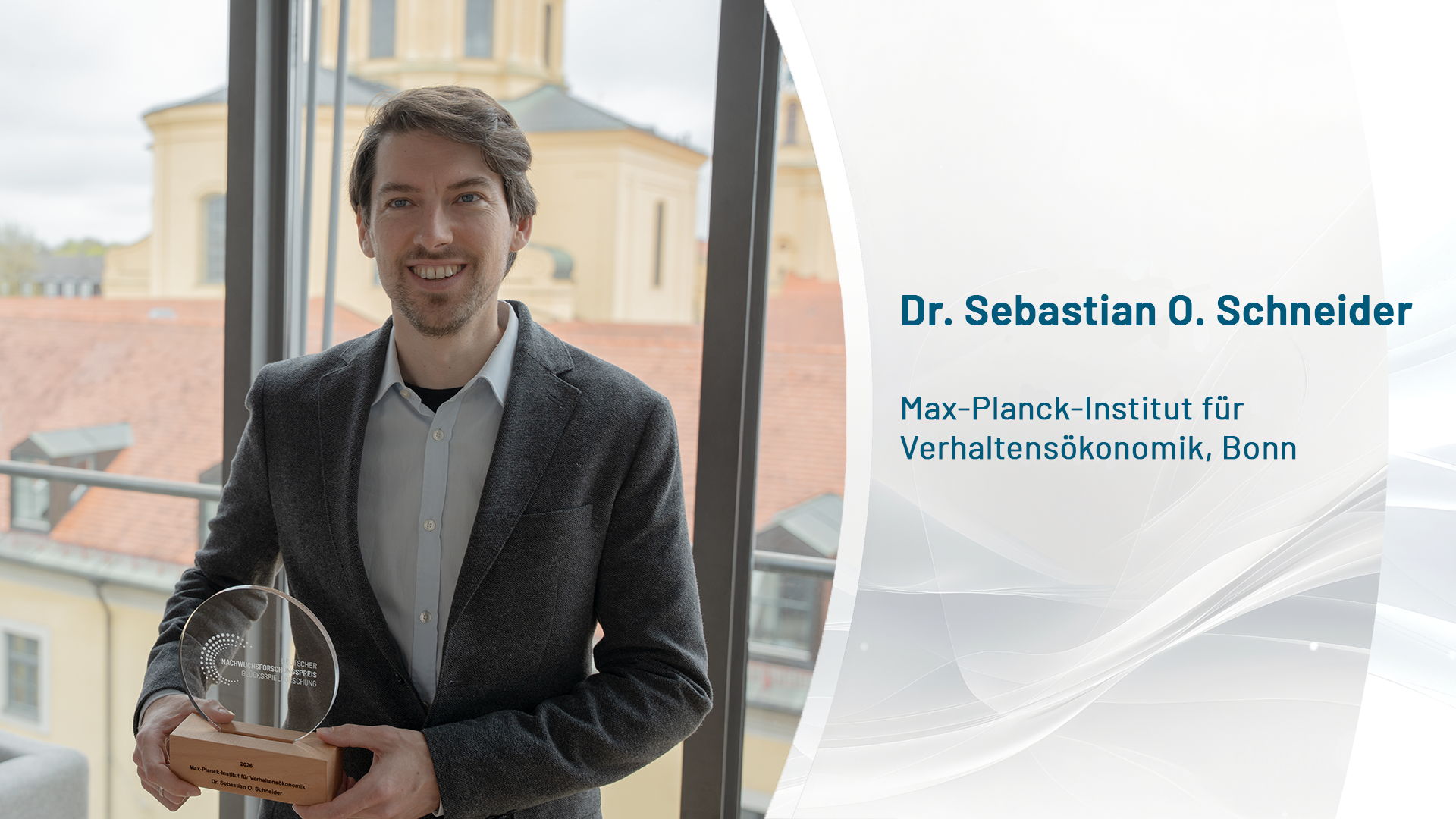
On the 13th April 2026, the Deutsche Stiftung Glücksspielforschung gGmbH awarded the
German Young Researcher Award on Gambling Research 2026 during an international science symposium in Munich.
The independent, internationally renowned Scientific Advisory Board of the Foundation has selected
Sebastian O. Schneider
From the Max Planck Institute for Behavioral Economics, Bonn
Due to his scientifically outstanding, innovative work:
“Risk Preferences and Field Behavior: The Relevance of Higher-Order Risk Preferences”,
which was published in the high-impact Journal American Economic Review (https://doi.org/10.1257/aer.20211217),
as the only award winner in 2026.
To the content of the publication
The work of Schneider & Sutter (2025) experimentally investigates how higher-order risk preferences – in particular prudence (caution) and temperance (risk diversification) – are related to actual behavior in everyday life (“field behavior”).
The authors develop new experimental methods to precisely measure higher risk preferences in addition to classic risk aversion. In a large-scale experiment with 658 young people, they show that these preferences are systematically related to real behavior – such as health behavior, addiction (e.g. Smartphone use), financial decisions and prevention behavior. Their finding is central that prudence and temperance are often much better predictors for real behavior than classic risk aversion.
Iment of the work for gambling research
The study has several important, new implications for gambling research:
1. Extension of the concept of risk
Gambling decisions are traditionally modeled by risk aversion. However, the work shows that this may be too short: Behavior under uncertainty also depends on how people distribute risks (temperance) or react to future uncertainty (prudence).
2. Explanation of inconsistent findings
In gambling research, there are often contradictory results for predicting gambling behavior by risk measures. The authors show that these inconsistencies can arise if higher risk preferences are ignored.
3. Better understanding of addictive behavior
Particularly relevant is the finding that Prudenz strongly with addiction-like behavior (e.g. Excessive use, potentially gambling), while risk aversion often does not sufficiently explain this.
4. Measurement Methodological Consequences
According to the study, common surveys on “risk-taking” not only risk aversion, but also higher risk preferences. This explains why they often predict gambling behavior better than laboratory measures.
Overall, the work extends the focus of gambling research from a one-dimensional risk concept to a multidimensional understanding of risk decisions. It thus provides a theoretically and empirically sound basis for explaining gambling behavior – especially problematic or addictive gaming – in a more differentiated way.
To the prize winner
Sebastian O. Schneider is a behavioral economist and heads the research group “Behavioral Economics and Data Science” at the Max Planck Institute for Behavioral Economics in Bonn. In his work, he examines how people decide at risk and uncertainty – with applications from financial and health topics to socially relevant issues such as addictive behavior and climate protection.
He received his doctorate with distinction in economics and combines experimental methods with modern data analysis in his research. His work has been published in the American Economic Review and the European Economic Review, among others.
In addition to his scientific activities, Dr. Schneider develops new methods and software for measuring risk behavior and advises international research projects.
His research provides important impulses for politics, business and society – especially in dealing with uncertainty, risk decisions and behavioral changes.
Winner of the German Young Researcher Award on Gambling Research 2025
Dr. Lara Marie Rolvien
On 28. On 1 April 2025, the first German Young Research Prize for Young Talent Research was awarded to Dr. Lara Marie Rolvien, Head of the E-Mental Health Working Group at the University Hospital Hamburg-Eppendorf .
The study “A Self-GuidedInternet Based Intervention for the Reductionofof Gambling Symptoms”, published 2024 in JAMA Network Open, examines the <span class="s
Background
Many people with problematic gambling behavior do not seek help – among other things out of shame, lack of information or lack of therapy offers. Online self-help programs could offer a low-threshold alternative here.
Goal
The effectiveness of an extended online program (based on cognitive behavioral therapy, metacognitive training, acceptance and commitmenttherapy as well as motivational Interviewing) in people with gambling problems.
Conclusion
The study shows that a self-guided online intervention can be effective in improving gambling behavior in people with gambling problems, especially in motivated usersn with heavy load, . The results support the use of such digital offers to overcome existing supply gaps, also possibly as a player protection tool for players with gambling disorder in the transition to outpatient or inpatient therapy services, e.g. after a player ban.
The German Foundation for Gambling Research gGmbH congratulates Dr. Rolvien on the decision of the scientific jury to award her excellent and innovative research work with the first German Young Research Award for Gambling Research!
The selection process
1. Requirements for the qualification of the Advisory Board
The applications are evaluated by an internationally recognized scientific jury in the form of an Scientific Advisory Board. The members of the Scientific Advisory Board must have the following qualifications:
- Academic Excellence: Members have a strong academic background and have a doctorate or equivalent qualification in a relevant field. They should be known for their own scientific contributions, which are evidenced by their research publications and other scientific activities.
- Professional experience: Members should have extensive experience in their respective field of research. This should ideally include years of research, teaching or policy development in their field.
- Interdisciplinary understanding: Given the multifaceted nature of gambling research, which includes psychology, sociology, economics, public health and other areas, the jury members should represent different scientific disciplines.
- International recognition: Members should be recognized beyond their own country. This can be indicated by international cooperations, positions in international organizations, awards from international committees or participation in the editorial boards of international journals.
- Ethical reputation: The members of the jury should have an impeccable ethical record. This includes compliance with standards for scientific integrity, maintaining confidentiality in the review process and avoiding conflicts of interest.
2. Criteria
The evaluation framework consists of five key criteria, which can be assumed to capture the most important aspects of effective research. These criteria provide a comprehensive and balanced approach to evaluating the merits of the award-nominated research. They are intended to highlight the depth and breadth of the contribution of research in this field, the novelty and severity of its methodology, the potential social and political implications of its results and their agreement with the mission and objectives of the German Innovation Prize for Gambling Research and the German Gambling Research Foundation gGmbH.
a) Relevance for the field
This criterion evaluates how closely research is linked to the field of gambling and/or gambling addiction. It is examined whether the work addresses central topics, challenges or knowledge gaps in these areas. An excellent rating in this category would represent research that can make a significant contribution to this area by addressing critical questions or problems and possibly leading policies or interventions related to gambling and/or gambling addiction.
b) Innovation
This measures the degree of novelty and originality in research. It is examined whether the work introduces new theories, methods or insights into the study of gambling and/or gambling addiction. It can also be addressed whether the research deals with a unique aspect or a perspective that has not yet been thoroughly researched. Research that performs very well in this category would break new ground and possibly lead to a paradigm shift in the way gambling and/or gambling addiction are understood and approached.
c) Scientific rigor
This criterion evaluates the quality of research design, methodology, and analysis. It is checked whether the work is methodologically well-founded, the results are robust and the conclusions are well supported by the evidence. An excellent score in this category would identify research that exemplifies best practices in research design and methodology.
d) Possible effects
This evaluates the potential of research to have a significant impact on our understanding of gambling or the prevention of gambling addiction or the improvement of consumer welfare. It is examined whether research could guide policies, influence practices and/or contribute to improving the lives of players, their social environment and the wider community. High-score research in this category would have a clear, demonstrable potential to bring about meaningful, positive changes in the real world with regard to gambling and/or gambling addiction that go beyond academic contributions.
e) Orientation to the mission
This criterion assesses how well the research is in line with the mandate and values of the Deutsche Stiftung Glücksspielforschung gGmbH. It is examined whether the work contributes to the promotion of innovative research that contributes to the better understanding and prevention of gambling addiction and to the improvement of consumer welfare, including research into the full spectrum of gambling (pathological and non-pathological). An excellent score in this category would characterize research that is closely linked to the mission and objectives of the foundation and contributes significantly to it, including the objectives of § 1 GlüStV 2021.
3. First check
After receipt of the full nominations, each member of the jury conducts an initial examination of each nomination. This evaluation focuses on innovation, scientific rigor, the potential impact of research and the orientation towards the mission statement of the Deutsche Stiftung Glücksspielforschung gGmbH.
4. Shortlist of nominations
After the first review, the jury meets to compile a shortlist of possible prize winners, which is achieved through a joint evaluation of the submissions. In this phase, the jury’s goal is to include all nominations that have a legitimate potential to be candidates for the award to ensure they get to the next phase of the review.
5. Assessment by specialist colleagues
The peer review process may involve obtaining the views and findings of external experts who are recognized in the field of gambling research and/or are subject matter experts in closely related disciplines. These experts, who are not part of the jury, are selected ad hoc on the basis of their knowledge and understanding of the specific research areas that represent the shortlisted applications that are not already reflected by the jury.
Each peer reviewer is assigned a review tailored to his field of expertise. Their task is to review the submission in detail and to assess the scientific value, originality and innovative nature of the research, the potential impact of the work and the suitability of the nominee(s).
In their review, the reviewers are encouraged to explain the special contributions of the nominated research and to comment on their relevance and applicability to the larger field of gambling research. They are also asked to put the work in a broader scientific context to help the jury understand its significance and possible impact.
The role of peer reviews is advisory in nature and provides a comprehensive understanding of the value and potential impact of the work on the field. However, the final decision depends on the collective evaluation of the jury, which decides which nomination best matches the objective of the German Innovation Award for Gambling Research and contributes the most to the progress of the field.
6. Final consultation and decision
Following the peer review process, the advisory board meets again to discuss and decide on the final winners. Your decision-making process is holistic and takes into account all five key criteria.
The consultation process is as follows:
In order to be considered in the final round for potential award winners, the nomination should be approved unanimously by the jury. A unanimous decision means a clear consensus among all members of the jury on the value and importance of the research.
In the final deliberations, the jury strives for a unanimous decision on the selection of the prize winner. If a unanimous decision is not possible, a majority decision shall be implemented. In the event of a tie, in which two or more nominations receive the same number of votes, a tie-breaker procedure will be initiated. The jury can obtain the decisive vote from an external expert who is not a member of the jury. This person must have a similar professional qualification to the jury and only consider the applications that constitute the tie.
7. Abstention
There may be situations in which a jury member abstains from voting. Abstention may occur if a jury member is of the opinion that they cannot make an impartial decision, e.g. For example, if there is a conflict of interest with a particular nomination, or if a member of the jury believes that he or she does not have sufficient expertise to adequately assess a particular nomination. Abstentions are respected and do not count towards the total number of votes. The decision shall be taken on the basis of the votes cast by the other members. Jury members who abstain from the vote may choose to terminate their abstention if the remaining jury members delete the specific nomination that led to the abstention.
Other considerations
1. Revisions
Guidelines and procedures will be reviewed and revised as needed to ensure that they continue to reflect best practices and adhere to the highest standards of fairness and rigor that align with the mission of the German Innovation Prize for Gambling Research.
2. Confidentiality and transparency
The German Innovation Award for Gambling Research is committed to reconciling the need for confidentiality to ensure the integrity of the evaluation process with the desire for transparency in its way of working. The aim is to create trust and credibility and at the same time to preserve the privacy of the nominees and the deliberations of the jury.
a) Transparency of the process
The general structure of the procurement procedure is publicly available, which illustrates the comprehensive and objective nature of the procedure. However, in order to ensure the authenticity of the selection process, details of the internal discussions, consultations and evaluations of the jury will be treated confidentially.
b) Confidentiality in peer review
The peer review procedure must be kept strictly confidential in order to allow an open exchange of scientific evaluations and opinions. This openness is crucial to ensuring a comprehensive and unbiased evaluation of each nomination.
c) Confidentiality of the nominees
The names and specific research details of the nominees will not be disclosed during the evaluation process. This security measure serves to protect the privacy of all nominees and to prevent possible external influence on the process.
d) Confidentiality Agreement
Each member of the Advisory Board, the external reviewers and the administrative staff involved in the procurement process sign a confidentiality agreement. These documents reaffirm their commitment to the protection of the privacy and intellectual property of the nominees.
e) breach of confidentiality
Any breach of confidentiality will be treated promptly and with the utmost seriousness. Any person who has violated their confidentiality agreement can be dismissed from their function and must expect further legal consequences.
f) Announcement of the prize winners
After the final decision has been made and the winners have been informed, the identity of the prize winners and a general justification for their selection will be published. This disclosure allows the Foundation to recognize and recognize excellence and innovation in gambling research.
g) Unsuccessful nominees
Information about unsuccessful nominations, including the identity of the nominees, will be kept confidential. However, in the interest of transparency, aggregated statistical information on the number and major research areas of the nominations can be disclosed.
h) Request for transparency
The Foundation is committed to openness and will strive to answer questions about the procedure and the award criteria. However, these answers will be within the limits set by the need to respect the privacy of the nominees and to preserve the integrity of the process.
3. Meeting minutes
A record of all advisory board meetings is kept. These minutes document the procedural elements of the meetings, including the members present, the main discussion topics and the general decisions, without disclosing specific details of the nominations or the relevant deliberations.
The minutes are made available to all Advisory Board members to ensure mutual understanding and agreement on the procedure. However, they remain confidential documents that are not made available to the public or the nominees to protect the privacy of the discussion and the integrity of the decision-making process.
In the event of transparency issues, an editorial version of the protocol may be provided upon official request, in which confidential and sensitive information is omitted. This decision is at the discretion of the Advisory Board and is taken with the utmost care to maintain the balance between transparency and confidentiality.
This protocol policy underscores the award’s commitment to process integrity by ensuring a recorded track of decisions while ensuring the open exchange of scientific opinions and ratings, the privacy of nominees, and the general fairness of the award process.
The jury of the research awards

Dr. Brett Abarbanel
Professor
University of Nevada Las Vegas (UNLV), USA

Dr David C. Hodgins
Professor
University of Calgary, Canada

Dr Debi A. LaPlante
Professor
Harvard University, Boston, USA

Dr. Kahlil Philander
Professor
Washington State University, Seattle, USA
Application and selection process
Overview of the process from submission to award ceremony-
Beginn der Bewerbungsphase 01.07.2025
-
Bewerbungsschluss 30.09.2025
-
Erstellung Short-List erste Novemberwoche 2025
-
Peer-review aller Short-List-Kandidaten bis 31.01.2026
-
Preisverleihung 13.04.2026
Benötigte Informationen
- Forschungszusammenfassung
- Institutionelle Befürwortung
- Lebenslauf des Hauptautors
- Motivationsschreiben (Erklärung zu den Auswirkungen auf die Glücksspielforschung, Relevanz für den Auftrag der Vergabe) - BESONDERS WICHTIG!
- Nachweis der Veröffentlichung
- Deklaration von potentiellen Interessenskonflikten
Beispiele für Dokumente
Privacy Policy
Data processing for the purpose of the German Innovation Award for Gambling Research and the German Young Talent Research Award for Gambling Research- What personal data is processed for which purpose?
For the implementation of the research competition “German Innovation Prize for Gambling Research” and the “Young Talent Research Award”, we process personal data of the participants. In particular, the following data are collected:
Your name; your e-mail address; your academic background; your professional experience; your personal research contribution; the name of the submitting research institution; the name of the contact person of the submitting research institution; names of the authors of the letter of recommendation; All other personal data (in particular CV, publication list and other relevant indicators for proof of expertise) that you provide when submitting your submission; period in which you are active in research after receiving your degree (only for the German Young Gaming Award Research).
If you win a research prize for a specific year, your name and information about your research will be published on our website.
- On what legal basis is this data processed?
The processing of the data is based on Art. 6 para. 1 lit. b GDPR. The processing, including the publication of your name and information about your research (if you should win a research prize) is necessary for the fulfillment of the contract (i.e. participation in the research competition) between the participant and us.
- Are there any other recipients of the personal data besides the data controller?
Your submission (and any personal information contained therein) will be shared with the following recipients:
- the jury,
- other scientists who are involved in the peer-review process or in the tie-breaker process as external examiners.
- How long is the data stored?
The data of all participants will be stored for the respective year for up to 3 years after the announcement of the prize winner.
A list of the prize winners (name and research) will be published and available on our website as long as the German Innovation Award on Gambling Research or the German Young Researcher Award on Gambling Research are awarded.
The detailed data protection declaration including all rights can be found at:
Privacy Policy